The Science of Memory: Understanding the Forgetting Curve
PART 1. You're Not Alone in This Struggle
The Frustration of Repeated Learning
"I've got it this time. I'll never forget this before the exam."
Do you remember that moment when you stayed up all night studying, confident you had it down? But the next morning, what you worked so hard to memorize the day before has already started to fade. "I'm sure I had it perfectly memorized yesterday..." After experiencing this frustration repeatedly, you naturally start to wonder:
"Am I just not smart enough?" "Is there something wrong with my memory?"
No. Your memory is perfectly normal. This is a characteristic of every human brain.
The Harsh Truth Revealed by Science
In the 19th century, German psychologist Hermann Ebbinghaus systematically studied human memory. He memorized meaningless syllables and measured how much he remembered over time. The results were shocking.
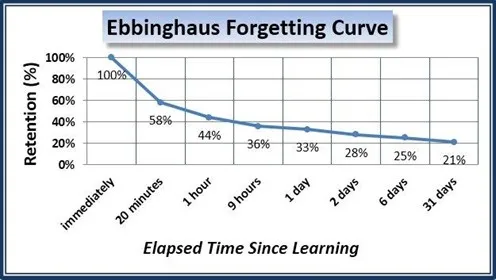
Forgetting happens much faster than you think:
- After 20 minutes: 42% of what you learned disappears
- After 1 hour: 56% is forgotten
- After 1 day: 67% evaporates
- After 1 month: 79% is erased from memory
In other words, what you studied for 4 hours is reduced to just 1 hour's worth after a single day.
This is the "Forgetting Curve." This is why we end up cramming right before exams, and why we have to study the same material repeatedly.
PART 2. There Is a Way to Overcome Forgetting
The Scientifically Proven Solution: Spaced Repetition
Fortunately, Ebbinghaus didn't just discover the problem. He also found a way to overcome forgetting: "Spaced Repetition."
The core principle of spaced repetition is simple:
"Reviewing right before you forget strengthens memory."
Why This Method Is Special
Let's think about typical learning approaches:
- Cramming: 10 hours of intense study the night before → most is forgotten right after the exam
- Unplanned repetition: Reviewing randomly → either reviewing what you already know or reviewing too late
In contrast, spaced repetition:
- Reviews at the optimal timing when forgetting begins
- Gradually increases intervals with each review
- Achieves 2-3 times higher memory retention with the same time investment
PART 3. The Learning Mechanism Proven by Neuroscience
What Happens in Your Brain
What happens in your brain when you learn new information?
Stage 1: Temporary Storage in the Hippocampus
Newly learned knowledge is temporarily stored in the hippocampus, a kind of "short-term memory notebook" that temporarily holds new information.
The problem is that the hippocampus has limited capacity. As new information keeps coming in, older information naturally gets pushed out. This is where forgetting begins.
Stage 2: Synapse Strengthening
Each time you review, the synapses—connections between brain neurons—become stronger. What started as a thin, weak connection becomes as strong as a thick cable with repeated reviews.
To put it simply: It's like a path in the forest. An unused path becomes overgrown, but when many people walk it repeatedly, a clear path naturally forms.
Stage 3: Migration to the Cortex (Long-term Memory Formation)
With sufficient repetition, information moves from the hippocampus to the cortex. Now the information is stored across multiple areas of the brain, and you can recall memories independently without the hippocampus's help.
This is "long-term memory."
Stage 4: Forgetting Rate Approaches Zero
Long-term memory isn't permanently stored. More accurately, it's a state where "the forgetting rate approaches almost zero." The synaptic circuits become so strong that they don't easily disappear.
Why Spaced Repetition Is Powerful
Principle 1: Desirable Difficulty
Reviewing right before you forget requires effort to recall the memory. This effort itself strengthens the synapses. Learning is maximized when you need a bit of effort rather than when recall is too easy.
Principle 2: Gradual Interval Increase
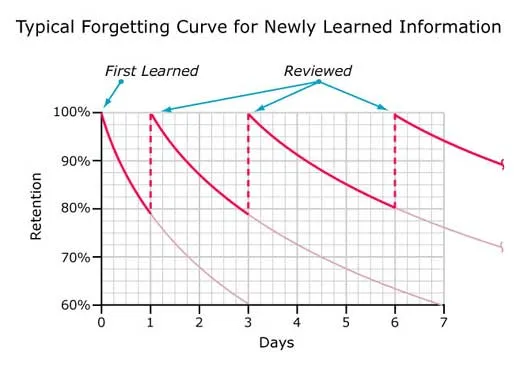
The optimal review cycle verified by research:
- 1st review: 1 day after learning
- 2nd review: 3 days after learning
- 3rd review: 1 week after learning
- 4th review: 2 weeks after learning
- 5th review: 1 month after learning
Since the forgetting rate slows with each review, you can gradually increase the interval between reviews. What started as one day can eventually become one month.
Principle 3: Distributed Learning Effect
With the same 4 hours invested:
- Massed learning: 4 hours at once → effectiveness 1
- Distributed learning: 1 hour × 4 times → effectiveness 2-3
The brain imprints memories more deeply when you forget and then recall them. Memory retention increases dramatically even with the same time investment when learning is distributed.
Scientific Evidence
This method is not just theory:
- Verified by over 100 years of psychological research
- Mechanisms proven by neuroscience
- Effectiveness confirmed in numerous real learning situations (language learning, medical education, certification exams, etc.)
PART 4. Applications: Everywhere Memorization Is Needed
Spaced repetition is effective in any field that requires memorization:
Language Learning
- Converting 5,000 English words into long-term memory
- Naturally acquiring grammar rules and example sentences
- Preparing for TOEIC, TOEFL, TOPIK, and other exams
Certification Exams
- Efficiently memorizing vast amounts of regulations and concepts
- Reaching passing level in a short period
- Maintaining knowledge needed for practical work long after the exam
Professional Knowledge
- Medicine: anatomical terms, drug information, disease classification
- Law: legal provisions, precedents, legal principles
- Accounting: account categories, accounting principles, tax law
Programming
- Mastering syntax and APIs
- Internalizing algorithm patterns
- Memorizing framework usage
General Learning
- Historical timelines and events
- Scientific formulas and concepts
- Various exam preparation
PART 5. The Reality Barrier: Why It's Hard to Practice
The Theory Is Perfect, But...
"Okay, I understand that spaced repetition is effective. Let me start practicing tomorrow!"
A few days later...
"Wait, which words did I review yesterday that I need to review again today?" "When did I last review this formula?" "Should I review what I studied 3 days ago tomorrow or the day after?"
Human Limitations
Let's think realistically:
- You're studying 500 English words
- Each word has a different last review date
- Each is going through different review cycles
- New words are added every day
"Word A is due in 3 days, Word B in 1 week, Word C tomorrow..."
How many people can manage this in their heads?
Maybe use Excel? Checking and updating hundreds of items daily is itself a tremendous effort. Eventually, the management becomes tedious and you give up.
Result: Failure of Scientific Learning Methods
- Missing optimal review timing
- Wasting time reviewing what you already know
- Eventually falling back to cramming everything the night before the exam
What's the use of knowing a good method if you can't practice it?
PART 6. The Solution: Nemo Automates Everything
Leave the Complex Calculations to the Machine
This is where Nemo comes in.
Nemo is a learning app that perfectly implements the forgetting curve and spaced repetition theory. A scientifically verified algorithm automatically manages all your learning cards.
You only need to do one thing: "Just review what Nemo tells you to review today."
Nemo's 4 Core Features
1. Scientific Review Algorithm
Nemo automatically calculates individual review schedules for each card:
- Newly learned card: Review after 1 day
- After 1st review: 2nd review after 3 days
- After 2nd review: 3rd review after 1 week
- Then 2 weeks → 1 month → 2 months...
It automatically applies the optimal timing verified by forgetting curve research.
2. Smart Review Notifications
- Selects only cards that need review today
- No time wasted on unnecessary reviews
- No worry about missing review timing
3. Efficient Time Management
- Convert hundreds of cards to long-term memory with just 10 minutes a day
- No need to plan—just see "today's tasks"
- Check learning progress at a glance
4. Proven Effectiveness
- 2-3 times higher memory retention with the same time investment
- Knowledge persists long after exams end
- Saves learning time in the long run
Real Usage Scenarios
Morning Commute (10 minutes) → Open Nemo to see "23 cards to review today" → Complete a light review during your commute
Lunch Break (5 minutes) → Add 15 new words learned yesterday → Nemo automatically creates review schedule
Before Bed (10 minutes) → Check additional cards to review today → Finish the day's learning
One Month Later → Less than 30 minutes invested daily → Over 500 words converted to long-term memory → No need for last-minute cramming before exams
PART 7. Start Right Now
Don't Fight Forgetting
The forgetting curve is a natural characteristic of our brains. It's not something you can overcome with willpower alone.
But you can overcome forgetting by using science.
With Nemo
- No more worrying: No need to calculate when and what to review
- Maximize efficiency: Save time by reviewing only at optimal timing
- Guaranteed results: Form solid long-term memory with scientifically proven methods
What You Need to Do Is Simple
- Learn new content and create cards
- Review as Nemo tells you
- Let Nemo and your brain handle the rest
No more frustration. Science will take care of your learning. Start with Nemo today.